
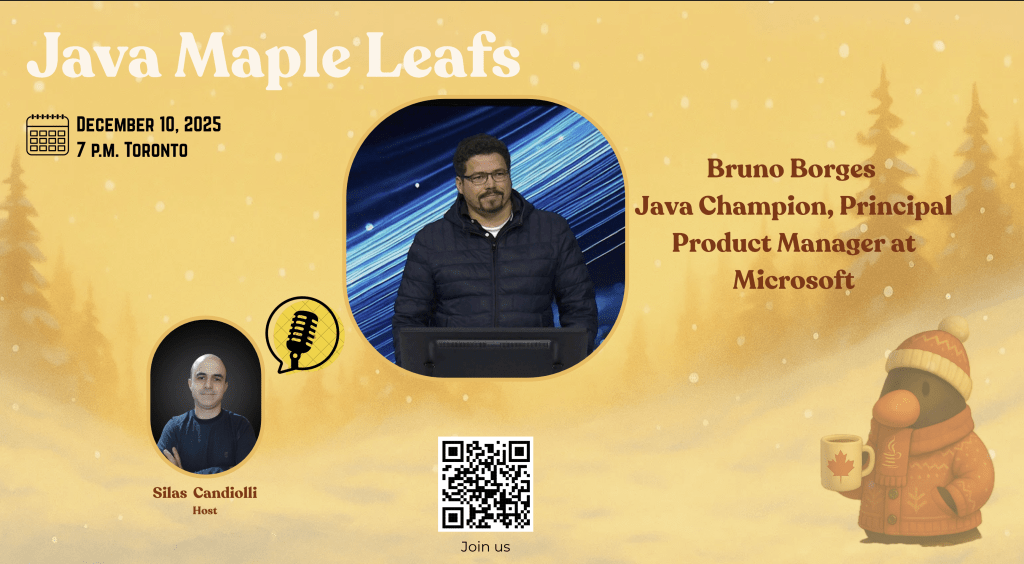
In this episode of Java Maple Leafs, I had the privilege of speaking with Bruno Borges—a Java Champion, Product Manager at Microsoft, and world-renowned speaker. Bruno brings his vast experience to the table to discuss Developer Experience, using AI to empower developers and businesses, and, of course, the journey of immigration to Canada.
Let’s dive in.
1. The “Unusual” Path: Negotiating the Future
While many developers look for student visas or direct hires to move abroad, Borges took a different, more strategic route. He describes his journey as “very unusual” compared to most people he has met over the last decade.
His strategy began years before he ever left Brazil. During his interview process for Oracle in São Paulo back in 2012, he was already planting the seeds.
“Part of my interview process to join Oracle that I negotiated with my manager at the time was that after about two to three years… I was interested in joining Oracle USA.”
He was transparent about his long-term goal—”I see myself in California”—and then spent the next two years proving he was indispensable to the US teams. He worked hard to establish relationships with the Oracle USA office so that when the time came, “people in that office know you… They are willing to go the extra mile to make it possible for you migrate.”
2. Seizing the Wave: The WebLogic & Docker Story
Borges illustrates the concept of “preparation meeting opportunity” with a pivotal moment in 2013. When Docker “exploded” and became a phenomenon, he immediately saw the potential for Oracle’s WebLogic server.
“I felt like this is amazing. I can have a WebLogic installation on everywhere. I can just do Docker run and my WebLogic is up and running. That’s awesome,” he recalls.
Without anyone asking, he wrote the Docker files and initiated Oracle’s presence on GitHub.
“The very first project of Oracle on GitHub is the container image project that I started around 2013… I was managing the Oracle presence on GitHub without anybody asking.”
This initiative paid off when a customer eventually asked the US engineering team for WebLogic on containers. While the team was initially skeptical, Borges was ready with a solution that worked. This combination of technical foresight and initiative was his ticket to the US. It wasn’t just about coding skills—”there are like 300 million people in the US,” he notes—but the “unique combination of my skills and most importantly the networking, the relationship that I built.”
3. The Surfer Analogy
Borges uses a surfing metaphor to explain career readiness. You can be a great surfer, but if you aren’t in the right spot in the ocean, you won’t catch the wave.
- The Ocean: The tech market.
- The Wave: A new trend or opportunity (like Docker in 2013 or AI today).
- The Position: Your prepared skills and network.
“Who gets to surf that wave?” he asks. “Is it the best surfer, or is it the surfer that is at the best place… to surf that wave?” The goal is to be “on the sand reading the ocean” so that when the wave comes, you are already paddling in the right direction.
4. Career Advice: The “Skip Manager”
To navigate corporate structures, Borges advises developers to build relationships with their “skip manager” (their boss’s boss).
- Your Manager: Focuses on the day-to-day, unblocking tasks, and project success.
- Your Skip Manager: Focuses on the long-term vision and career trajectory.
Having a connection with leadership ensures you aren’t lost during reorgs and helps you understand the broader business “ship”—so you know where to steer your own career.
5. Java in the Age of AI
Is Java still relevant for the next wave of intelligent apps? Borges gives a “solid yes.”
He points out that Large Language Models (LLMs) understand Java extremely well because of the decades of “content online… documentation or tutorials or blogs” available for training. Furthermore, while Python is great for data science experimentation, enterprises want the type safety and stability of Java for production applications. He cites the rise of tools like LangChain4j, Spring AI, and Semantic Kernel as proof that the ecosystem is adapting fast.
6. The Developer as Communicator
Borges concludes with a thought-provoking look at the future of the profession. As AI begins to write more of the “boilerplate” code, the human developer’s role shifts from typing characters to defining intent.
“We as developers have always complained that business people did not know how to write business requirements for developers… and now we are the business people telling AI business requirements to write the code for us.”
Success in the AI era will depend on communication skills—the ability to clearly articulate architecture, constraints, and logic to an AI agent. The developer of the future isn’t just a coder; they are an architect and a reviewer.
