
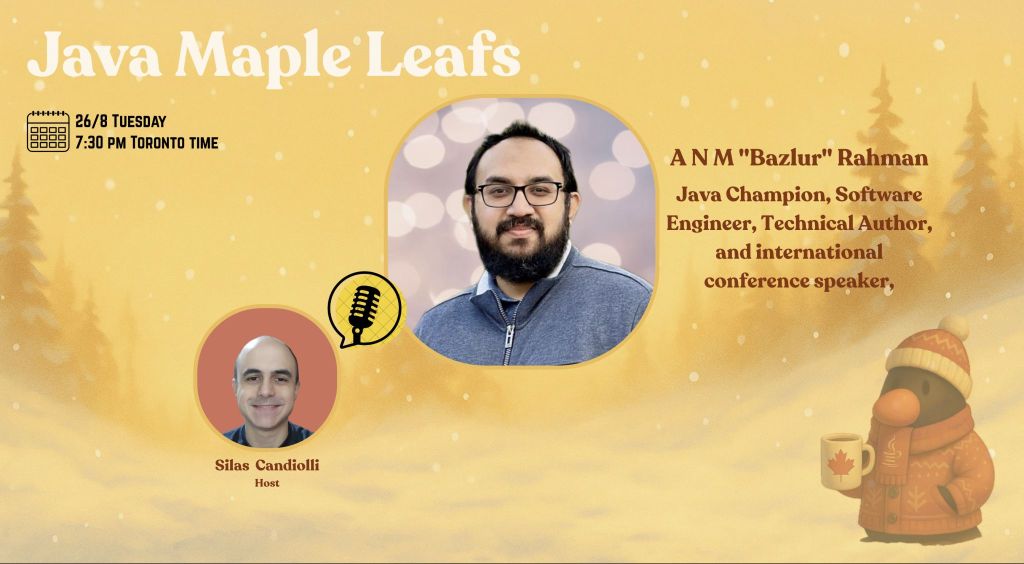
In this episode of Java Maple Leafs, I had the pleasure of talking with Bazlur Rahman – Java Champion, software engineer, technical author, community leader, and conference speaker.
Currently based in Toronto, Bazlur has spent much of his career advancing the Java ecosystem and recently published a book on one of the hardest but most important topics in our field: Modern Concurrency in Java.
Bazlur’s Journey with Java
Bazlur’s story with Java started early, and his passion has only grown stronger with time. After graduating, his first job was in a Java-based company.
From there, he moved between different companies, always finding Java at the heart of his work. Alongside his professional career, he built a thriving Java User Group in Bangladesh, connecting with like-minded developers and nurturing a strong local community.
“I started building a community called Java User Group Bangladesh… by doing that, I got a lot of friends who had the same mindset. They wanted to talk about technology, about software engineering, and that helped me stay involved.”
Why Concurrency Matters
Concurrency has always been one of the most challenging aspects of software development. Java developers historically struggled with threads, executors, and synchronization. Yet, the evolution of the language has transformed the way we think about parallelism. Now we have tools that make concurrent programming more approachable.
Bazlur highlights that the introduction of virtual threads (Project Loom) and new abstractions are lowering the barrier to writing efficient, concurrent applications. This is not just an incremental change, it’s a shift in how developers can design scalable systems in Java.
Lessons from Writing Modern Concurrency in Java
The motivation for Bazlur’s book stemmed from years of observing developers struggle with concurrency, often resorting to avoiding it altogether. His book serves as a bridge between the traditional threading model and the modern concurrency tools available in Java today.
“That’s one of the key reasons I wrote this book — to make concurrency accessible to more developers, with clear explanations and practical guidance.”
Key lessons he shares:
- Concurrency should not be feared; it can be understood and mastered.
- New features like virtual threads simplify patterns that were once overly complex.
- Writing about concurrency forces clarity — if you can explain it simply, you really understand it.
Closing Thoughts
Talking with Bazlur was a reminder that while Java has been around for decades, it continues to reinvent itself. Concurrency, once considered one of the most painful aspects of programming, is now becoming more approachable and powerful thanks to the language’s evolution.
Bazlur’s new book, Modern Concurrency in Java, is not just a technical deep dive; it’s a guide for the next generation of Java developers to embrace concurrency with confidence.
