
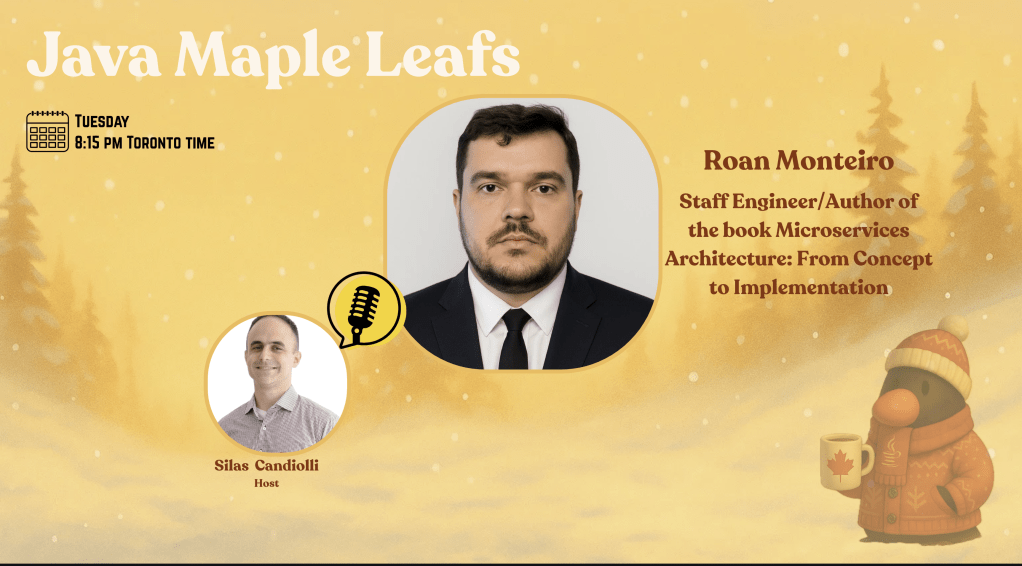
In the third episode of Java Maple Leafs, I had the privilege of talking with Roan, a Java engineer whose career spans over 15 years. From his early days at IBM in Brazil to his work in Canada, Roan has specialized in Java and Microservices. But what stands out in his story is how he turned his expertise into a book project — written in Portuguese, for the community.
Roan’s Path with Java
Roan’s journey with Java began in 2008 at IBM, where he built his foundation in enterprise software. Over time, he became deeply involved in microservices architecture, a specialization he carried from Brazil to Canada in 2020. For him, Java has been more than a programming language , it’s been the constant companion through his career growth, international relocation, and architectural specialization.
The Microservices Book Project
When the pandemic hit, Roan decided to tackle a new challenge: writing a book in Portuguese about microservices. The goal was to make knowledge accessible to developers in Brazil who struggle with English-language resources. This project, Microservices Journey, brought together nearly 30 contributors and took two years to complete.
Roan also participated in the community-driven series Jornada Java, where he wrote a chapter on APIs. These experiences gave him the confidence to structure larger projects.
Lessons from Writing About Microservices
Writing a book on microservices is not just about compiling technical patterns, it’s about translating complex, evolving practices into something other developers can apply in real projects.
Roan shared how the first challenge was scope:
“To organize the ideas and define the scope was a challenge. Microservices has so many deep topics, like DDD, but we needed something more hands-on and direct to the point.”
Instead of producing a massive academic guide, Roan and his co-authors focused on practical, scenario-driven guidance, so readers could quickly connect the theory to real-world systems. That is something really important, raraly manage to absorb content without a real world scenario.
Another key lesson was about misconceptions in the industry. Many companies claim they’re running microservices, but the reality often falls short.
By addressing this gap, Roan aimed to help developers understand not just how to build Microservices, but how to recognize when they’re not truly decoupled.
Finally, writing in Portuguese brought its own lessons. By creating accessible content for developers in Brazil, the project showed the importance of contextualizing global knowledge into local communities. It wasn’t just about technology; it was about breaking language barriers.
Closing Thoughts
What inspires me most in Roan’s story is the blend of technical mastery and human motivation. His career reflects the adaptability of Java developers worldwide, while his writing shows the importance of building bridges and sharing knowledge in local languages.
Roan’s story reminds us that our craft is not only about code, it’s also about the people we help through it.
You can find the Roan’s book available at Amazon on the link below.
🎧 To hear more about Roan’s journey with Java, microservices, and his writing projects, check out the full episode on YouTube.
